
No products in the basket.
Website Design Website Development Guide for 2026 Success
Master website design website development for 2026 with expert strategies…

Did you know that 94% of first impressions are shaped by your website’s design and functionality? In 2026, the website redesign process is more than a visual upgrade, it is about preparing your digital presence for what lies ahead. As technology races forward and user expectations climb, a strategic approach is essential.
This guide will lead you step by step through the website redesign process, ensuring your site is not only visually impressive but also aligned with your business goals and the latest trends. Ready to transform your website into your most valuable asset? Let’s begin your journey to digital success.
In 2026, the website redesign process is more than a cosmetic update. It is a vital step for businesses aiming to thrive in a digital-first world. Understanding why a redesign is necessary helps you make informed decisions, keeping your site relevant and competitive.
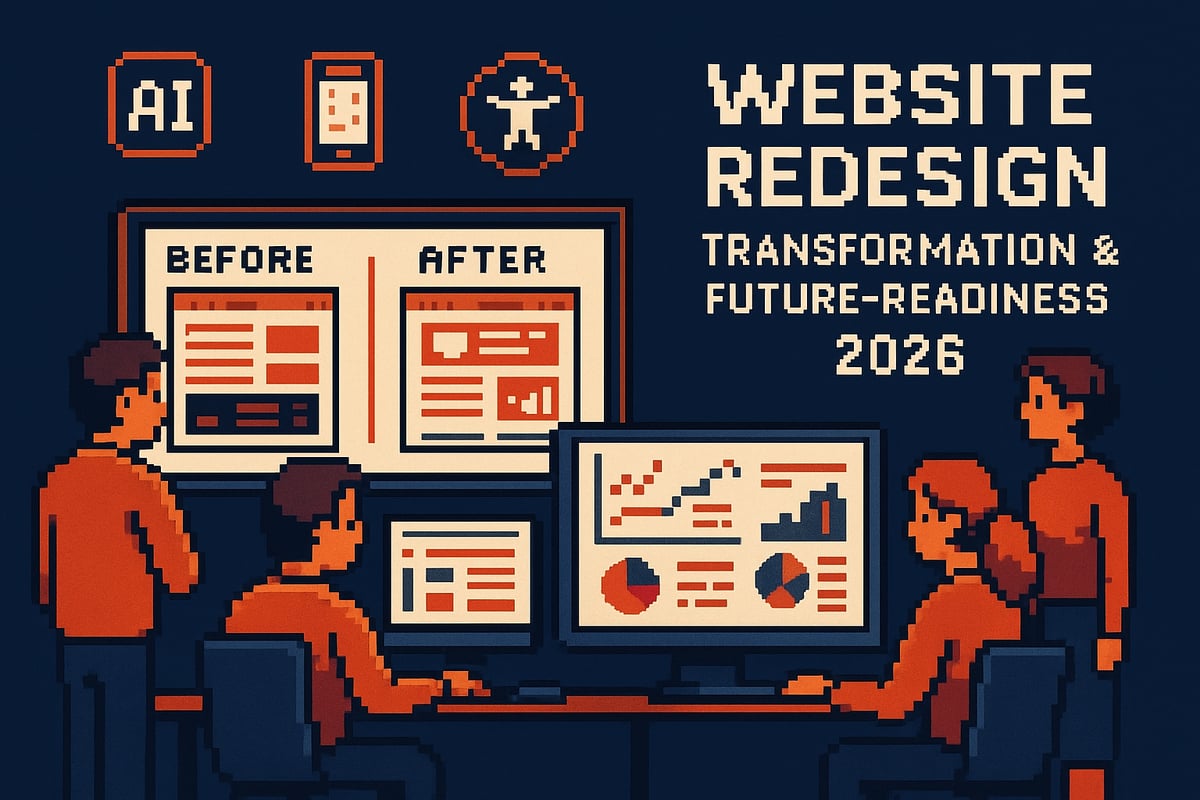
The digital world in 2026 is shaped by rapid innovation. Artificial intelligence, personalisation, and voice search now define how users interact with websites. Expectations for speed, seamless navigation, and accessibility are higher than ever. Most users browse across multiple devices, making mobile-first and omnichannel experiences essential.
Businesses that invest in the website redesign process stay ahead by adopting the latest trends. Leading brands use redesigns to outperform competitors and improve customer engagement. According to Website redesign statistics 2025, 88% of online consumers are less likely to return after a poor website experience. This highlights the importance of regular updates to meet evolving standards.
Several factors prompt organisations to begin the website redesign process. The most common triggers include:
Each of these issues can impact your site's effectiveness. Regularly reviewing your website ensures it continues to reflect your brand and supports your business objectives.
Ignoring the website redesign process brings significant risks. A dated or slow website can erode customer trust and credibility. Competitors who embrace new technology quickly gain an advantage.
Missed opportunities for revenue and lead generation become real concerns. For example, a business that invested in a strategic redesign saw a 43% increase in profit, demonstrating the tangible impact of staying current. The risks of falling behind include lost market share and potential security breaches.
A well-planned website redesign process offers measurable benefits. Improved user engagement and retention help build long-term loyalty. Enhanced brand positioning differentiates your business in a crowded market.
| Benefit | Impact | Supporting Data |
|---|---|---|
| User Engagement | Higher retention rates | Up to 400% ROI (industry data) |
| Brand Differentiation | Stronger market presence | Increased recognition |
| Scalability | Easier future updates | Cost-effective growth |
| Conversion Optimisation | More sales and leads | 43% profit growth (case study) |
Investing in user experience and functionality pays off with higher returns and greater resilience.
The website redesign process is not just about aesthetics. In 2026, it is a business-critical investment that supports growth and innovation. With new tools, changing user needs, and emerging standards, timing matters more than ever.
Approach your redesign as an opportunity for transformation, not just maintenance. A strategic, user-centred process ensures your site is ready for the challenges and opportunities ahead.
Embarking on a website redesign process in 2026 begins with thorough planning and discovery. This phase is pivotal for setting the right direction and ensuring your investment delivers measurable results. By investing time upfront, you minimise risks and lay a solid foundation for every decision ahead.

Defining clear goals is the backbone of any successful website redesign process. Start by aligning your website objectives with your broader business strategy. Are you aiming to increase leads, boost e-commerce sales, or enhance brand perception?
Set measurable KPIs for each objective. For example, a B2B site might focus on lead generation and form submissions, while an e-commerce platform prioritises conversion rates and average order value.
Establishing these benchmarks early allows you to track progress post-launch. Review existing analytics to identify what’s working and where improvement is needed. This clarity shapes every subsequent step in the website redesign process.
A successful website redesign process requires buy-in from all key stakeholders. Identify everyone who will influence or be affected by the new site, including marketing, sales, IT, and leadership.
Conduct interviews or workshops to gather insights, align expectations, and address concerns. Regular communication, such as weekly check-ins, keeps everyone engaged and informed.
Transparent collaboration helps prevent misunderstandings and ensures the project remains on track. By involving stakeholders early, you reduce the risk of costly changes later in the website redesign process.
Understanding your users is essential to the website redesign process. Begin by building detailed user personas that represent your primary audiences. Map out their typical journeys, from first visit to desired action.
Analyse your current site’s analytics, heatmaps, and user feedback to uncover pain points. Tools like session recordings or funnel analysis reveal where users drop off or encounter friction.
Surveys can provide direct insight, for example, uncovering why users abandon checkout. This research ensures your redesign addresses real user needs and supports business goals.
A comprehensive content audit is a critical step in the website redesign process. Review every page and asset for relevance, accuracy, and performance. Identify content that should be updated, removed, or repurposed.
Look for gaps where new content could add value or where existing material can be mapped more effectively to the buyer’s journey. Collaboration between marketing and SEO teams ensures your content supports both user engagement and search visibility.
Document your findings in a structured inventory. This clarity prevents duplication and guides the creation of new, impactful content.
Technical and competitive analysis underpins a robust website redesign process. Audit your current site’s architecture, CMS, integrations, and load speed. Identify any limitations that could hinder future growth.
Research competitors to benchmark features, design trends, and user experience standards. Evaluate compliance with regulations like GDPR and WCAG, as well as security practices.
This analysis highlights both risks and opportunities, helping you future-proof your site. It also provides a reference point for measuring the effectiveness of your redesign.
A detailed project roadmap brings structure to the website redesign process. Outline each phase, set realistic timelines, and assign responsibilities.
Define key milestones, from discovery to launch, and anticipate common blockers such as resource bottlenecks or shifting priorities. Risk management strategies, like regular reviews and scope control, help maintain momentum.
For a full breakdown of how this phase fits into the wider project, see the Website design and build process. A transparent roadmap keeps everyone aligned and accountable throughout the website redesign process.
Many agencies now use four-week discovery workshops to align vision and strategy before any design work begins. These sessions bring stakeholders together to clarify objectives, research users, and define technical requirements.
Industry data shows that investing in discovery can reduce project overruns by up to 30 percent. This proactive approach ensures the website redesign process starts with a shared vision and clear priorities.
By setting a strong foundation, you position your project for success and minimise costly surprises later on.
The strategy and design phase is where your website redesign process truly comes to life. This stage transforms research and planning into a tangible experience that resonates with your users and aligns with your business vision. Every decision made during this phase shapes how visitors perceive your brand and interact with your site.

At the core of a successful website redesign process is a clearly defined design strategy. Begin by crafting a creative brief that details your objectives, audience insights, and brand voice. This document should serve as a north star, guiding every creative decision.
Collaborative workshops and mood boards help the team align on visual direction. These tools streamline feedback, ensuring all stakeholders share the same vision. For example, mood boards can quickly surface preferences around colour, typography, and imagery, reducing revision cycles.
A well-structured approach in this phase sets the foundation for the rest of your website redesign process, making it easier to translate strategy into compelling visuals.
Information architecture is the blueprint of your website redesign process. Start by mapping out a logical site structure with a clear sitemap. This ensures users find what they need quickly and intuitively.
Wireframes, both low- and high-fidelity, bring these ideas to life. They allow you to visualise layouts for key pages and map user flows that support conversion goals. According to industry insights, sites with strong structure see up to 50% more user engagement.
Use diagrams and flowcharts to communicate navigation paths, and revisit these as your website redesign process evolves to ensure ongoing alignment with user needs.
Visual design brings personality and consistency to your website redesign process. Apply your brand guidelines to every digital element, from colour palettes to typography and imagery. Responsive layouts are essential, adapting seamlessly across devices and screen sizes.
Incorporate micro-interactions and subtle animations for a modern, engaging feel. Before-and-after visuals can powerfully demonstrate the impact of refreshed branding and layout improvements. These design upgrades not only enhance aesthetics but also reinforce trust and recognition throughout your website redesign process.
Content is the voice of your website redesign process. Start by aligning copy with your brand’s tone and your users’ intent. Structure headings, paragraphs, and calls-to-action for clarity, accessibility, and SEO.
A content-first design approach ensures that messaging leads the creative direction. Designers and copywriters should collaborate closely, producing cohesive and compelling user journeys. This partnership accelerates time-to-launch and ensures your website redesign process delivers clarity at every touchpoint.
SEO and accessibility are integral to every website redesign process. Conduct keyword research, optimise on-page elements, and structure content for both users and search engines. Integrate accessibility features like alt text, ARIA labels, and semantic HTML from the outset.
Meeting WCAG 2.2 standards is both a legal and business necessity in 2026. For a deeper dive into aligning design and technical optimisation, see Web design and SEO integration.
Proactive integration in your website redesign process ensures your site reaches the widest possible audience and maintains compliance.
Continuous refinement is vital throughout the website redesign process. Use interactive prototypes to gather feedback from stakeholders and real users. This approach allows for usability testing and quick adjustments based on actual behaviour.
Regular review cycles keep the team aligned and help surface issues early. Adapting designs based on data and feedback ensures your website redesign process remains user-centred and agile, delivering a stronger final product.
Remember, strategy and design are inseparable in the website redesign process. Form must follow function to create a seamless experience. Early investment in UX and accessibility will provide measurable returns after launch.
By embedding these best practices, your website redesign process becomes a catalyst for transformation, positioning your business for sustained success in 2026 and beyond.
The development and implementation phase is where the website redesign process comes to life. This stage transforms strategic plans and creative concepts into a high-performing, future-ready digital platform. A meticulous approach ensures your new site is robust, scalable, and fully aligned with your business objectives.

Before coding begins, the website redesign process requires careful preparation. Teams finalise all approved designs, technical specifications, and content assets. Creating a detailed visual style guide and clear documentation ensures consistency throughout development.
Set up separate environments for development, staging, and production. This structure allows for safe testing and smooth deployment. Preparation at this stage minimises errors and keeps the website redesign process on schedule.
A well-prepared foundation supports efficient collaboration and effective project delivery.
In 2026, the website redesign process leverages cutting-edge development approaches. Section-based development enables transparent progress tracking and real-time previews. Teams use mobile-first and progressive web app (PWA) methodologies to ensure optimal performance on all devices.
Integration with headless CMS, e-commerce, and third-party tools is now standard. For example, platforms like WordPress and WooCommerce offer flexibility, scalability, and ease of use. To maximise results, consider working with specialists in WordPress web development expertise who can tailor solutions for your business.
These modern practices ensure your website redesign process delivers a secure, future-proof site ready for growth.
The heart of the website redesign process lies in building both front-end and back-end systems. On the front end, developers focus on fast load times, secure architecture, and accessible interfaces. Responsive design guarantees a seamless experience across desktops, tablets, and mobiles.
Back-end development involves robust integrations, such as CRM and ERP systems. A well-chosen CMS empowers non-technical users to manage content with ease.
| Aspect | Front-End Focus | Back-End Focus |
|---|---|---|
| Speed | Fast loading, caching | Efficient queries |
| Security | HTTPS, secure code | Data protection |
| Accessibility | Semantic HTML, ARIA labels | User permissions |
A strong technical stack is vital for long-term success in the website redesign process.
Quality assurance safeguards the integrity of the website redesign process. Teams conduct cross-browser and device compatibility testing to catch visual or functional issues early. Both automated and manual QA are essential for uncovering hidden bugs and usability problems.
Performance audits, security checks, and compliance reviews ensure the site meets industry standards. User acceptance testing (UAT) involves real stakeholders and provides valuable feedback before launch.
A thorough QA process reduces post-launch issues, protects your reputation, and builds trust with your audience.
Technical SEO is woven into the website redesign process from the ground up. Developers implement schema markup, sitemaps, and redirects to support search engine visibility. Analytics and tag management tools are set up to track conversions and user behaviour.
Compliance with GDPR, CCPA, and WCAG standards is mandatory. Teams verify that privacy policies, cookie banners, and accessibility features are in place. This proactive approach prevents costly penalties and improves user trust.
Continuous monitoring ensures the website redesign process delivers ongoing value and keeps your site secure.
Migrating content is a critical step in the website redesign process. Teams transfer data from legacy platforms with zero downtime, safeguarding SEO rankings and preserving internal link structures. A mix of automated scripts and manual checks helps verify data accuracy.
Key tasks include:
The goal is a seamless transition, ensuring the new site launches with all assets intact and fully functional.
Preparing for launch is a pivotal moment in the website redesign process. The transition from development to live site can determine whether your investment pays off or risks are realised. A structured approach at this stage is essential for a seamless go-live and lasting success.
Thorough quality assurance is the backbone of a successful website redesign process. Before launch, every functionality, integration, and user pathway must be tested. This minimises the risk of critical errors and negative user experiences.
A comprehensive QA checklist covers:
| Area | Checks |
|---|---|
| Functionality | Forms, buttons, navigation |
| Integrations | Third-party tools, e-commerce, APIs |
| Performance | Load times, stress tests |
| Accessibility | WCAG 2.2 compliance, screen readers |
| Security | SSL, data protection, vulnerability scans |
Pre-launch QA can reduce post-launch issues by 80 percent. However, even with the best preparation, unexpected pitfalls can occur. To avoid becoming part of the 80 percent of failed redesigns, see Common website redesign pitfalls.
Training is a critical yet often overlooked aspect of the website redesign process. Your team needs to know how to use new features, update content, and troubleshoot minor issues.
Agencies typically offer:
Empowering stakeholders ensures the website redesign process delivers ongoing value, not just a one-time launch event.
A well-planned launch is vital to the website redesign process. Timing, coordination, and contingency planning are key.
Steps for a smooth go-live:
Sites with structured launch plans experience 60 percent fewer critical errors. The website redesign process should always include a clear checklist and timeline for launch.
SEO and analytics are integral to the website redesign process. Before go-live, ensure all technical SEO elements are in place.
Essential checks include:
Proper analytics configuration allows you to measure the impact of the website redesign process from day one, ensuring visibility and performance.
Effective communication is the final safeguard in the website redesign process. Notifying both internal teams and external users ensures clarity and readiness.
Key communication tasks:
Change management supports a positive transition, reducing confusion and building excitement around the new site.
Many agencies remain on standby during the critical hours of the website redesign process, ready to resolve last-minute issues. This proactive approach can mean the difference between a smooth launch and a crisis.
For example, structured launch processes have resulted in 60 percent fewer critical errors, boosting confidence and momentum post-launch. Early post-launch support is essential for ensuring your team can manage and optimise the site with minimal disruption.
A well-executed website redesign process at this stage sets your business up for long-term digital success.
The website redesign process does not end at launch. True digital success comes from continuously refining your website to meet evolving user needs, business goals, and industry standards. Post-launch optimisation is essential for maximising your investment and staying ahead in the competitive landscape.
After launch, monitoring your site’s performance is a critical step in the website redesign process. Use analytics platforms, heatmaps, and user session recordings to track how visitors navigate your pages.
Key metrics to review include:
| Metric | What it Reveals |
|---|---|
| Conversion Rate | Effectiveness of CTAs |
| Bounce Rate | User engagement |
| Load Time | Site speed impact |
| Exit Pages | Where users leave the journey |
Analysing these data points helps identify friction and opportunities for improvement. For example, a spike in bounce rate may indicate usability issues that need urgent attention.
User and stakeholder feedback is invaluable for ongoing success in the website redesign process. Collect comments through surveys, feedback widgets, and customer interviews. Analyse this qualitative data alongside analytics to spot trends and prioritise enhancements.
Regularly run A/B and multivariate tests to compare different versions of key pages. Small changes, like adjusting button colours or headlines, can lead to significant improvements in conversion. Iteration based on real user input ensures your site evolves in line with expectations.
Continuous SEO, security, and compliance checks are non-negotiable in the modern website redesign process. Schedule regular SEO audits to maintain rankings and update content for new keywords. Proactively monitor for security threats, apply updates, and ensure backups are in place.
Stay current with evolving regulations, such as GDPR and WCAG, to protect your business and users. Automated tools can simplify compliance and alert you to potential risks before they escalate.
Your website redesign process should include a strategy for ongoing content and feature updates. Add new articles, case studies, and product pages to address audience needs and support business growth. Expand functionality based on user demand, such as integrating chatbots, advanced search, or e-commerce features.
To stay ahead of the curve, keep an eye on web design trends 2026 and adopt innovations that enhance user experience and accessibility. This proactive approach ensures your site remains relevant and competitive.
Conversion Rate Optimisation is a cornerstone of the website redesign process. Use funnel analysis, form tracking, and behaviour analytics tools to identify where users drop off. Implement targeted improvements, such as simplifying forms or refining calls to action.
According to website redesign ROI benchmarks, businesses that invest in ongoing CRO see substantially higher returns. A single well-executed test can lead to double-digit profit growth, proving the value of continuous optimisation.
Securing the long-term success of your website redesign process requires robust support and maintenance. Choose a support plan that covers technical updates, security monitoring, and regular health checks. Managed services provide peace of mind, ensuring your site stays fast, secure, and compliant.
Typical support plan features include:
A proactive support strategy minimises downtime and maximises your site’s impact.
The website redesign process in 2026 is set to be more dynamic, data-driven, and user-focused than ever before. As digital innovation accelerates, businesses must anticipate change and adopt emerging trends to stay relevant. This section explores the most significant shifts shaping the future of the website redesign process, offering actionable insights for forward-thinking organisations. For a deeper dive into current and emerging trends, you can find more in this analysis of Affordable website design trends.
Artificial intelligence is now a central force in the website redesign process. AI-driven personalisation tailors content and product recommendations to individual users in real time. Chatbots provide instant support, while machine learning analyses user behaviour to refine site design and navigation. Agencies increasingly use AI-powered heatmaps and automated prototyping tools, enabling rapid iterations and evidence-based design decisions.
By incorporating these technologies, businesses streamline workflows and deliver exceptional user experiences.
The website redesign process now frequently adopts headless and API-first approaches. Decoupling the front end from the back end allows for greater flexibility and scalability. Content is delivered seamlessly across multiple channels, such as web, mobile, and IoT devices. Brands using headless CMS solutions can launch updates rapidly and integrate with emerging technologies without overhauling their entire platform.
Benefits include:
Embracing this architecture ensures your website remains agile and future-ready.
Accessibility is no longer optional within the website redesign process. Meeting and exceeding WCAG 2.2 standards is essential for legal compliance and ethical responsibility. Design teams focus on creating inclusive digital experiences for all users, regardless of ability or device. Features such as semantic HTML, ARIA labels, and high-contrast modes are integrated from the outset.
Key practices include:
Prioritising accessibility fosters trust and broadens your audience reach.
Sustainability is a defining concern in the website redesign process for 2026. Companies strive to build energy-efficient websites that minimise environmental impact. Optimising performance not only reduces hosting costs but also enhances user satisfaction.
| Metric | Sustainable Site | Traditional Site |
|---|---|---|
| Average Load Time | 1.2s | 3.8s |
| Carbon Footprint | Low | High |
| Resource Usage | Minimal | Excessive |
By prioritising speed, streamlined code, and green hosting, businesses demonstrate both environmental responsibility and best-in-class performance.
Data privacy and robust security are central to the website redesign process in 2026. With privacy laws evolving, proactive compliance with GDPR, CCPA, and similar regulations is imperative. Users are quick to abandon sites they perceive as insecure.
Best practices include:
A secure, privacy-first approach builds customer confidence and mitigates business risk.
The modern website redesign process is defined by collaboration and agility. Cross-functional teams work together in sprints, combining design, development, and marketing expertise. Agile methodologies enable rapid iteration, continuous feedback, and faster time to market.
Core elements:
These workflows reduce miscommunication and improve project outcomes.
Staying at the forefront of trends is vital for any website redesign process. The landscape in 2026 is holistic and user-centred, blending technology, creativity, and strategy. Forward-thinking businesses see redesign not as a one-off project but as an ongoing cycle of innovation and improvement.
By embracing best practices—AI, headless architecture, accessibility, sustainability, security, and agile collaboration—you ensure your website remains competitive and future-proof. The most successful organisations treat their website as a living asset, adapting continually to meet user needs and industry standards.
As you’ve seen throughout this guide, a successful website redesign in 2026 is about so much more than just a fresh look—it’s about building a future ready digital presence that truly supports your business goals. If you’re ready to take the next step and want expert support to navigate the process with confidence, we’re here to help. At Pixelish, we specialise in creating high performance, custom websites that convert and grow with your business. Let’s start a conversation about your unique needs and how we can help you achieve real results—Get in touch.




© Copyright 2025, All Rights Reserved by Pixelish