ECG Training provides essential training to healthcare professionals across the UK. Among their services, they supply Patient Group Directions (PGDs) – legal documents that allow pharmacists, nurses, and paramedics to administer specific medications without requiring an individual prescription. Getting these documents right isn’t optional. They’re a legal requirement, and any error has real-world consequences for the professionals relying on them in clinical settings.
We’ve worked with ECG Training for over three years. The relationship started when James, Pixelish’s founder, was looking after their site at a previous agency. Within a month of James leaving to start Pixelish, ECG Training had tracked him down and asked him to take over their websites. They’d been having issues with the previous agency not fully understanding how their site worked.
That says everything about how we approach client relationships.
PGDs are a legal requirement for many healthcare professionals. Before we stepped in, here’s how the process worked:
One full-time staff member was dedicated to processing PGDs, supported by a wider team. Customers would regularly chase up orders before the 3-day window was up, creating even more work for staff answering queries.
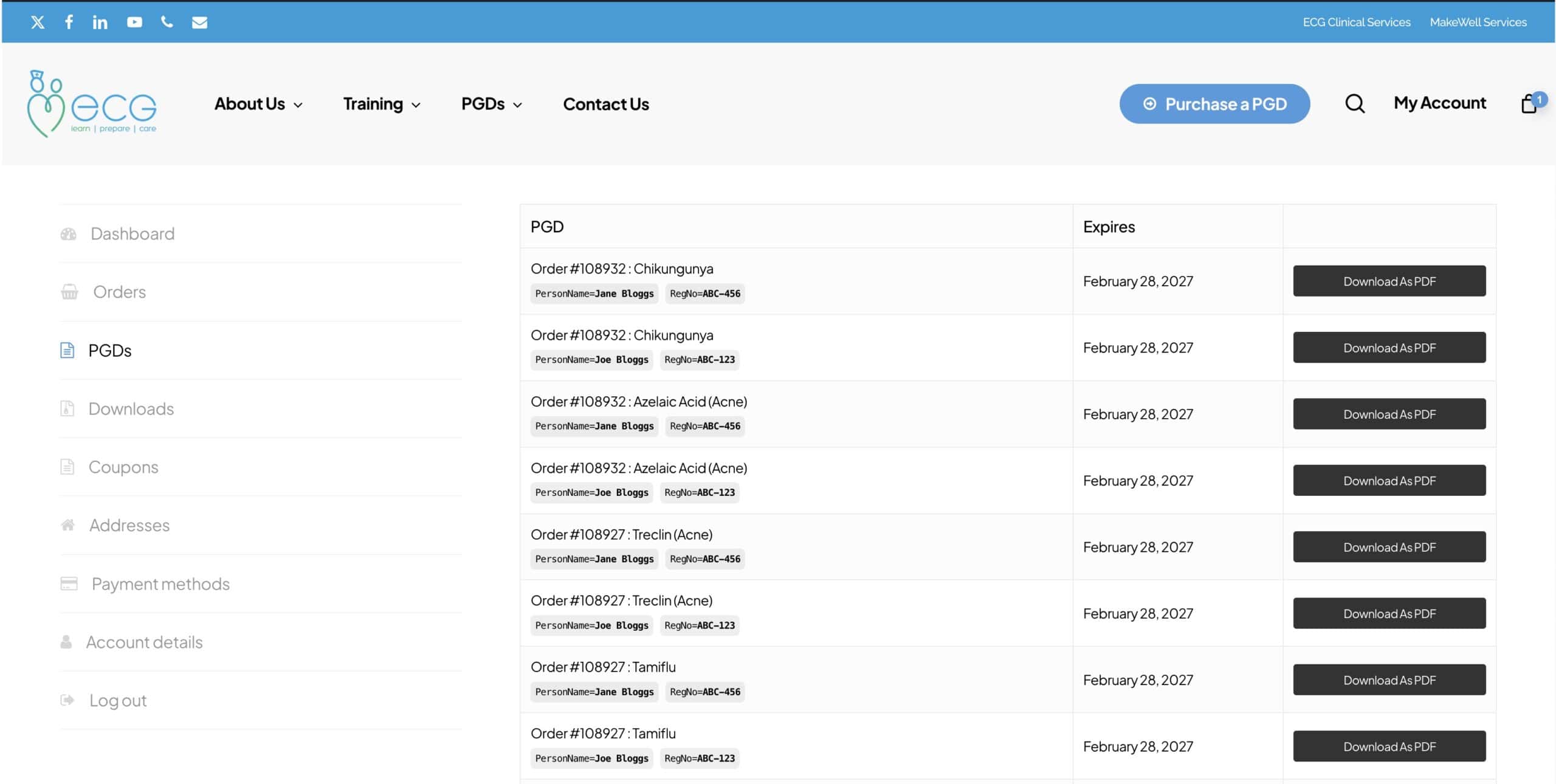
For customers buying the All Inclusive PGD package, the experience was particularly poor – they’d receive a single 150+ page document and have to hunt through it to find the relevant PGD somewhere inside it.
The process worked, but it didn’t scale. It created unnecessary stress for staff, and it certainly wasn’t the experience customers deserved – especially given the professional and legal nature of what they were purchasing.
We built PGD Docs – a custom WordPress system that automates the entire PGD generation and delivery process end to end.
Here’s how it works now:
For All Inclusive customers, instead of one unwieldy document, they now get 50+ individual PGDs – each one clearly labelled and easy to find in their account.
The system also handles the full paperwork lifecycle. PGDs expire after just over 12 months, so we built in automatic expiry management. When a PGD is approaching its expiry date, customers receive a reminder email. When it expires, it’s automatically removed from their account – keeping everything current and compliant.
We launched carefully – starting with a couple of popular PGD products, monitoring closely, ironing out edge cases, then expanding across the full range. The system now runs across two ECG Training websites, handling thousands of documents each year.
PGD Docs is built entirely on WordPress with custom development – no third-party document generation SaaS, no off-the-shelf plugin. The system is built on PHP 8.2 with WooCommerce, using custom hooks into the order lifecycle to trigger document generation at the point of purchase.

The checkout flow uses a custom pre-purchase form built on WooCommerce’s order processing hooks, capturing the professional’s registration number, role, and superintendent details before payment completes. Once the order is confirmed, the document generation runs automatically – no queue, no delay.
PGDs are stored against the customer’s account and flagged for expiry approximately 30 days before the 12-month window closes, triggering an automated reminder email. When the PGD expires, it’s removed from the account automatically.
The system was designed to handle edge cases from the start – customers who don’t complete checkout, orders with multiple PGD types, and bulk All Inclusive purchases generating 50+ individual documents simultaneously.
The legal accuracy requirements made this technically demanding. Each PGD contains specific fields that must be precisely correct – these are regulatory documents used by healthcare professionals in clinical settings. Getting the document generation logic right, and making sure it stayed right across 50+ different PGD types, required careful custom development and thorough testing.
We launched carefully – starting with a couple of popular products, monitoring closely, ironing out edge cases, then expanding across the full range. The system now runs across two ECG Training websites.
PGD sales doubled during peak season, processing time reduced from 3 working days to under 3 minutes, and the equivalent of 3 full-time staff freed from manual document processing – with zero changes to marketing spend.
Comparing peak season (August-November) year-on-year, PGD sales doubled.
Here’s the thing: we haven’t even mentioned the new system on the website yet. No marketing. No announcements. No email campaigns. The only thing that changed was the customer experience.
We think the growth comes down to two things: customers finding the process so straightforward that word spread, and the frictionless checkout converting more browsers into buyers.
That’s the new processing time. Customers get their PGDs almost instantly after completing their purchase.
The equivalent of three full-time staff worth of processing time has been eliminated. That team can now focus on customer service and other parts of the business rather than manually creating and chasing documents.
The customer provides their details. The system generates the document. No manual data entry means no transcription mistakes on legally sensitive documents that healthcare professionals rely on in clinical settings.
| Metric | Before | After |
|---|---|---|
| Processing time per PGD | 3 working days | Under 3 minutes |
| Staff time dedicated to PGDs | 1 FTE + team support | Zero manual processing |
| All Inclusive customer experience | Single 150+ page document | 50+ individual labelled PGDs |
| Human error risk | Manual data entry at every step | Fully automated – zero transcription |
| PGD sales (peak season) | Baseline | 100% increase |
What started as a few hours a month tidying up a messy WordPress backend has grown into something much bigger. We inherited a site with outdated plugins, 2,000+ lines of tangled code in functions.php, and years of work from multiple developers who’d each left their mark.
We stripped it back and rebuilt it properly. Then we built PGD Docs. Now we manage four websites for ECG Training’s parent group, with a fifth on the way.
We’re currently on Phase 3 of the PGD system – continuously developing it based on what the business needs. As Ben Moden put it, the system allows for a “fully bespoke system to operate based on the business and customer needs.” 2026 is when they plan to start actively marketing the new system. We’re looking forward to seeing what the numbers look like when they do.
This is what a long-term partnership looks like. We’re not an agency they call when something breaks. We’re their website team – without the overhead of hiring in-house.
See how we approached similar challenges for Rejuvenair Sanctuary (WooCommerce platform with subscriptions and product management) and U&I Renewables (large-scale WordPress build with 200+ automated pages).
This project was led by James Taylor, Director at Pixelish.
“The automation system has had a notable impact on both operational performance and customer experience.”
Since the PGD development introduction, customers now receive their PGDs instantly, resulting in smoother interactions and a marked improvement in satisfaction. The number of customers contacting the team to follow up on processing times has decreased almost entirely, demonstrating that the new automated workflow provides clearer expectations and more reliable turnaround times.
A key operational benefit has been the removal of the need for a staff member dedicated solely to issuing PGDs. With the system now performing this function automatically, internal resources have been freed up and can be redirected towards higher-value tasks. This shift has contributed to reduced operational costs and enhanced productivity across the team.
From the original work, we have throughout the year been able to develop the system more and more based on our requirements, which allows for a fully bespoke system to operate based on the business and customer needs.
Overall, the PGD automation system has delivered substantial improvements, transforming the PGD process into a streamlined, efficient and highly reliable workflow. It supports organisational goals, enhances customer experience, and ensures a consistent and timely service that benefits both the business and its users.