
No products in the basket.

Website Design Website Development Guide for 2026 Success
Master website design website development for 2026 with expert strategies…

E-commerce in the UK is experiencing unprecedented growth, making a strong online presence more vital than ever as we approach 2025. With UK e-commerce sales projected to exceed £150 billion by next year, both new and established businesses face stiff competition and unique challenges when building an effective e commerce web page.
A well-constructed online store offers benefits such as broader market reach, the ability to sell around the clock, and a seamless customer experience. This guide provides a clear, step-by-step approach to building your e commerce web page for 2025, sharing key strategies, tools, and proven best practices to help your business succeed.
Careful planning is the foundation of any successful e commerce web page. By taking a strategic approach from the outset, you set your online store up for long-term growth and resilience in a competitive landscape.

To build an effective e commerce web page, start by profiling your ideal customer. Use data-driven research from sources like Google Trends and Statista to identify buying habits, preferences, and emerging trends within your niche.
Analyse your competitors thoroughly. Look at their product offerings, user experience, and customer engagement methods. For example, Gen Z's preference for ethical brands and seamless mobile shopping is rapidly reshaping UK e-commerce.
Align every product and feature on your e commerce web page with real customer demand. Market insights ensure you invest resources where they matter most and avoid costly missteps.
Establishing precise objectives is vital for your e commerce web page. Define what success looks like, whether it's reaching a specific sales target, increasing average order value, or boosting conversion rates.
Set both short-term and long-term goals. For instance, aim to reduce cart abandonment rates or lower your customer acquisition cost. Use KPIs like sales growth, repeat customer rate, and industry benchmarks projected for 2025.
Regularly track your progress. Clear KPIs allow you to make informed decisions and adapt your e commerce web page strategy to achieve measurable results.
Selecting the ideal platform is a cornerstone decision for your e commerce web page. Options such as Shopify, WooCommerce, Magento, and BigCommerce each offer distinct advantages.
Consider factors like scalability, customisation, cost, and integration with other systems. Shopify dominates the UK hosted platform market, while WooCommerce offers flexibility for SMEs. Hosted platforms provide simplicity, whereas self-hosted solutions offer control and custom features.
Compare each platform's strengths and weaknesses in relation to your business model to ensure your e commerce web page can adapt as you grow.
| Platform | Scalability | Customisation | Cost | Support |
|---|---|---|---|---|
| Shopify | High | Moderate | Monthly | 24/7 |
| WooCommerce | Moderate | High | Variable | Community |
| Magento | High | High | High | Enterprise |
| BigCommerce | High | Moderate | Monthly | 24/7 |
Budgeting accurately is crucial for launching a robust e commerce web page. Factor in costs for website development, hosting, marketing, and ongoing maintenance. UK small businesses typically invest between £5,000 and £20,000 to get started.
Allocate resources for design, content creation, and technical support. Don't overlook ongoing costs for security updates and customer support. For detailed cost insights, explore How much does a website cost in 2025.
Plan ahead to avoid unexpected expenses and ensure your e commerce web page remains competitive and secure as your business scales.
Ensuring compliance is non-negotiable for any e commerce web page operating in the UK. Adhere to GDPR by having clear privacy policies and robust data handling practices.
Meet PCI DSS standards to secure online payments and protect customer information. Your site should also comply with WCAG 2.2 accessibility guidelines, ensuring users with disabilities can shop with ease.
Neglecting these areas can result in fines and lasting reputational damage. By prioritising legal requirements, you build trust and credibility for your e commerce web page from day one.
Creating a high-performing e commerce web page is essential for success in the UK's booming digital retail sector. Every element, from user experience to accessibility, shapes how visitors interact with your online shop. By focusing on both design best practices and the latest trends, you can transform browsers into loyal customers and ensure your business thrives in 2025.

A seamless user journey is the backbone of any high-converting e commerce web page. Clear navigation, logical site structure, and intuitive menus enable shoppers to find products quickly.
Mobile-first design is now crucial, with 75% of UK online shoppers preferring their phones. Fast loading times are equally vital, as delays directly increase bounce rates and lost sales. Prioritise concise menus, prominent search bars, and visible calls to action.
For professional support, consider partnering with E-commerce website designers UK who specialise in crafting user-centric online stores tailored for the UK market.
Consistent branding across every e commerce web page builds trust and recognition. Use a harmonious colour palette, professional typography, and high-quality imagery to reflect your brand’s personality.
Product images and videos should be crisp and detailed, offering multiple angles or even 360° views. Colour psychology plays a significant role; for example, blue conveys trust while red can create urgency.
A visually cohesive e commerce web page reassures customers and sets you apart from competitors, encouraging repeat visits.
Optimising each e commerce web page for product listings is critical to boost conversions. Every description should be detailed, unique, and focused on customer benefits. Incorporate high-resolution images with zoom and rotation features to provide a complete view.
Encourage user-generated content, such as reviews and ratings, which can increase conversion rates by up to 18%. Display trust badges and clear stock information.
A well-optimised product e commerce web page reduces uncertainty and motivates shoppers to complete their purchase.
A streamlined checkout process can dramatically lower the average UK cart abandonment rate of 69%. Design your e commerce web page to minimise unnecessary steps and distractions during checkout.
Offer multiple secure payment options, including credit cards, PayPal, and mobile wallets like Apple Pay or Klarna. Provide a guest checkout option for speed, but also allow account creation for future convenience.
Simplified forms and transparent costs on your e commerce web page help reduce friction and boost overall conversion rates.
With mobile commerce expected to dominate UK sales, your e commerce web page must be fully responsive. Adaptive layouts ensure that content displays perfectly on every device, from smartphones to desktops.
Incorporate mobile-specific features such as sticky call-to-action buttons and simplified input forms. Google’s mobile-first indexing means that mobile usability directly affects your search rankings.
Prioritising mobile optimisation ensures your e commerce web page stays competitive and accessible to the widest audience possible.
One in five UK consumers has a disability, making accessibility a non-negotiable aspect of e commerce web page design. Follow WCAG 2.2 guidelines by providing alt text for all images, enabling keyboard navigation, and selecting easy-to-read fonts.
Accessible design broadens your customer base and protects your business from potential legal risks. Test your site’s usability with assistive technologies to ensure all users can navigate and shop with confidence.
An inclusive e commerce web page not only complies with regulations but also demonstrates your commitment to serving every customer.
Building an effective e commerce web page for 2025 requires more than just attractive design. The right features and integrations are crucial for driving conversions, improving customer experience, and staying ahead of competitors. Let us explore the essential components every online store needs to succeed in the evolving UK market.
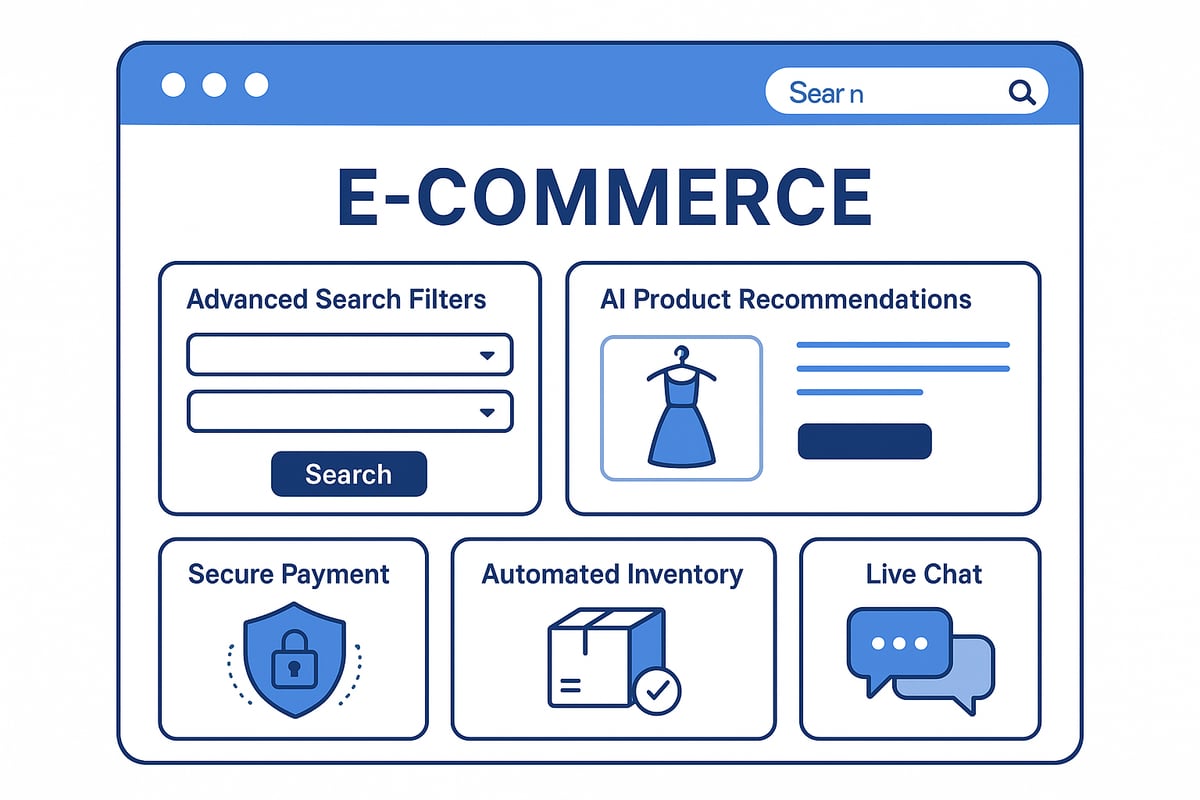
A high-performing e commerce web page should offer intelligent search and robust filtering. Shoppers expect to find products quickly, so integrating AI-powered search bars, autocomplete, and voice search can make navigation seamless.
Smart filters for attributes like size, colour, price, and availability help users narrow options efficiently. According to recent studies, 43 percent of shoppers abandon a site if the search experience is poor. By optimising these tools, your e commerce web page can reduce frustration and boost conversion rates.
Personalisation is a game-changer for any e commerce web page. Leveraging AI, stores can deliver dynamic product recommendations based on browsing behaviour, previous purchases, and real-time data. On-site messaging and personalised emails further tailor the experience to individual customers.
Research shows that personalisation can increase sales by up to 15 percent. For more on the latest personalisation strategies, see this guide to AI-driven personalisation in e-commerce. Implementing these tools helps your e commerce web page stand out and encourages repeat business.
Trust is non-negotiable on an e commerce web page. Integrating secure payment gateways such as Stripe, PayPal, and Klarna ensures customers can pay safely using their preferred method.
To further protect transactions, implement two-factor authentication, SSL encryption, and real-time fraud detection tools. PCI DSS compliance is essential for all online stores. Prioritising security not only safeguards your business but also reassures visitors that your e commerce web page is a safe place to shop.
Efficient inventory and order management are vital for any e commerce web page aiming to scale. Tools that provide real-time stock updates and low-inventory alerts prevent overselling and improve customer satisfaction.
Automated order confirmations and tracking keep buyers informed at every stage. Integrations with accounting and shipping software save time and reduce errors. By automating these processes, your e commerce web page remains accurate and responsive as your store grows.
Offering responsive customer support is key for a successful e commerce web page. Live chat, including both chatbots and live agents, gives customers immediate answers to their questions.
Providing a comprehensive FAQ and self-service knowledge base reduces support tickets and empowers users. Studies show that live chat can lift conversion rates by 12 percent. Investing in these features ensures your e commerce web page meets customer expectations for service and reliability.
Effective SEO and content strategies are vital for driving targeted traffic and increasing conversions on your e commerce web page. With competition intensifying in 2025, mastering each aspect of search and content will help your store stand out, attract buyers, and build brand authority. Here’s how to optimise your online shop for lasting success.

Start with thorough keyword research to shape your e commerce web page. Use tools like SEMrush, Ahrefs, or Google Keyword Planner to identify high-intent queries your customers use. Focus on long-tail keywords for your product and category pages, as these often convert better.
Optimise meta titles, descriptions, and headings for clarity and relevance. Add descriptive alt text to images to improve accessibility and boost your search rankings. Integrate schema markup to enhance your search listings with rich snippets. Consistent on-page optimisation ensures your e commerce web page is both discoverable and user-friendly.
High-quality content transforms your e commerce web page into a trusted resource. Create blog posts, buying guides, and video tutorials that address customer questions and showcase your products in action. Content marketing not only attracts organic traffic but also builds credibility and trust.
Video content is particularly powerful, increasing average dwell time by 88%. Share customer stories and product demos to engage visitors and encourage repeat visits. Consistent publishing helps establish your brand as an industry authority, supporting long-term SEO growth.
Technical SEO is the foundation of a high-performing e commerce web page. Ensure your site loads quickly, as speed affects both rankings and conversions. Use Google’s PageSpeed Insights to identify bottlenecks and improve Core Web Vitals.
Implement XML sitemaps and structured data to help search engines crawl and index your pages efficiently. Address duplicate content issues, especially with product variants and faceted navigation. For a deeper dive into best practices, explore this guide on SEO for e-commerce websites.
Building authority for your e commerce web page requires a proactive approach to link acquisition. Collaborate with influencers, industry blogs, and digital publications to secure high-quality backlinks. Quality links remain a top ranking factor in 2025.
Create shareable content, such as infographics or original research, to encourage natural linking. Engage in digital PR by pitching your brand’s story or unique selling points to relevant media outlets. Strong link profiles drive referral traffic and boost your search visibility.
Local SEO is essential for UK-based e commerce web page owners seeking to capture nearby customers. Optimise your Google Business Profile with accurate information, opening hours, and images. Encourage satisfied customers to leave reviews, which improve trust and local rankings.
Develop location-specific landing pages and blog content to target regional search terms. According to recent data, 46% of all Google searches are for local information, highlighting the importance of local SEO for your store’s growth. Consistent effort in this area helps you reach more UK shoppers and build lasting relationships.
Launching your e commerce web page is just the beginning. To build a successful online store in 2025, you need a strategic approach for smooth operation and sustainable growth. Let us walk through the essential steps to ensure your e-commerce journey is both profitable and future-proof.
Before your e commerce web page goes live, rigorous testing is vital. Start with cross-browser and device checks to confirm your site appears and functions correctly for all users. Test on desktops, tablets, and smartphones to catch any layout or usability issues.
Map the user journey from landing page to checkout. Identify any confusing steps or bugs that could disrupt conversions. Addressing these problems early can prevent costly mistakes. Remember, around 60% of users abandon sites with usability issues, so thorough quality assurance is non-negotiable.
Launching a polished e commerce web page builds trust and encourages repeat visits.
Once your e commerce web page is live, attracting customers becomes your priority. A strong digital marketing plan combines paid advertising, social media, and email campaigns. Leverage Google Ads and Facebook or Instagram Shopping to reach targeted audiences.
Email marketing remains a powerhouse, with an average ROI of £42 for every £1 spent. Use segmented lists and personalised content to recover abandoned carts and nurture repeat business. Social commerce is also on the rise, so integrate your store with popular platforms to boost reach.
A multi-channel approach ensures your e commerce web page stands out in a crowded market.
To sustain growth, monitor your e commerce web page with robust analytics. Set up Google Analytics 4 and enable e-commerce tracking to capture sales data, user behaviour, and conversion funnels. Regularly review your KPIs, such as average order value and cart abandonment rate.
A/B testing is your ally for ongoing optimisation. Test different layouts, product images, and call-to-actions to see what resonates with your audience. Use insights to refine your strategies and improve user experience.
Continuous improvement keeps your e commerce web page competitive and user-friendly.
As your e commerce web page gains traction, consider expansion. Add new products or categories to broaden your appeal. If you are ready for bigger growth, explore internationalisation with multi-currency and multi-language support.
The UK e-commerce market is forecast to reach £286 billion by 2025, so scaling up can unlock significant opportunities. Cross-border sales are projected to hit £35 billion, making international markets more attractive than ever. Use automation for inventory and order management to handle increased demand seamlessly.
Strategic scaling ensures your e commerce web page remains agile and profitable.
Sometimes, working with specialists accelerates your success. Consider partnering with an agency for advanced design, SEO, or technical support when your e commerce web page needs expert care. Outsourcing can be the right choice if you lack in-house expertise or want to focus on core business functions.
A professional agency offers tailored solutions, from bespoke development to ongoing optimisation. For those using WooCommerce, explore dedicated WooCommerce website agency services for guidance and support tailored to your platform.
Choosing the right partner for your e commerce web page can drive measurable results and long-term growth.
As you plan your journey to launching a high performing e commerce site in 2025, remember that having the right support can make all the difference. We've explored how tailored design, seamless user experience, and ongoing optimisation are key to building a store that truly converts. If you want expert guidance from a team with proven results and a client focused approach, I'm here to help you take the next step. Let's discuss your goals and how we can create a bespoke solution that fits your vision and budget.
Get a quote




© Copyright 2025, All Rights Reserved by Pixelish